Ebook Free Six Walks in the Fictional Woods, by Umberto Eco
So, simply be below, discover the e-book Six Walks In The Fictional Woods, By Umberto Eco now as well as read that swiftly. Be the first to review this e-book Six Walks In The Fictional Woods, By Umberto Eco by downloading in the link. We have other books to review in this website. So, you could locate them additionally easily. Well, now we have actually done to supply you the best e-book to review today, this Six Walks In The Fictional Woods, By Umberto Eco is really appropriate for you. Never neglect that you need this book Six Walks In The Fictional Woods, By Umberto Eco to make better life. On-line e-book Six Walks In The Fictional Woods, By Umberto Eco will actually offer simple of everything to read as well as take the perks.
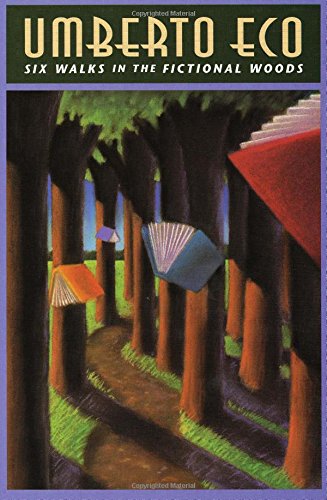
Six Walks in the Fictional Woods, by Umberto Eco

Ebook Free Six Walks in the Fictional Woods, by Umberto Eco
Some individuals might be giggling when looking at you reviewing Six Walks In The Fictional Woods, By Umberto Eco in your extra time. Some could be admired of you. And some could want be like you that have reading leisure activity. What about your own feel? Have you felt right? Checking out Six Walks In The Fictional Woods, By Umberto Eco is a requirement and a hobby at once. This problem is the on that particular will make you really feel that you have to review. If you know are looking for guide qualified Six Walks In The Fictional Woods, By Umberto Eco as the choice of reading, you could find right here.
The method to get this book Six Walks In The Fictional Woods, By Umberto Eco is quite simple. You could not go for some areas as well as invest the moment to only locate the book Six Walks In The Fictional Woods, By Umberto Eco As a matter of fact, you may not constantly get the book as you're willing. Yet here, only by search as well as discover Six Walks In The Fictional Woods, By Umberto Eco, you could obtain the listings of guides that you actually expect. Occasionally, there are lots of books that are revealed. Those publications certainly will certainly surprise you as this Six Walks In The Fictional Woods, By Umberto Eco collection.
Are you thinking about primarily publications Six Walks In The Fictional Woods, By Umberto Eco If you are still perplexed on which one of guide Six Walks In The Fictional Woods, By Umberto Eco that should be bought, it is your time to not this site to try to find. Today, you will require this Six Walks In The Fictional Woods, By Umberto Eco as one of the most referred publication and also a lot of required publication as sources, in various other time, you can appreciate for a few other publications. It will certainly depend on your ready requirements. However, we always suggest that publications Six Walks In The Fictional Woods, By Umberto Eco can be a great invasion for your life.
Also we discuss guides Six Walks In The Fictional Woods, By Umberto Eco; you could not locate the printed books below. A lot of compilations are given in soft data. It will specifically provide you more advantages. Why? The first is that you could not need to lug guide anywhere by fulfilling the bag with this Six Walks In The Fictional Woods, By Umberto Eco It is for guide remains in soft data, so you could wait in gadget. Then, you can open the gadget all over and check out guide effectively. Those are some few benefits that can be got. So, take all benefits of getting this soft documents publication Six Walks In The Fictional Woods, By Umberto Eco in this web site by downloading in web link supplied.
In Six Walks in the Fictional Woods Umberto Eco shares with us his Secret Life as a reader―his love for MAD magazine, for Scarlett O'Hara, for the nineteenth-century French novelist Nerval's Sylvie, for Little Red Riding Hood, Agatha Christie, Agent 007 and all his ladies. We see, hear, and feel Umberto Eco, the passionate reader who has gotten lost over and over again in the woods, loved it, and come back to tell the tale, The Tale of Tales. Eco tells us how fiction works, and he also tells us why we love fiction so much. This is no deconstructionist ripping the veil off the Wizard of Oz to reveal his paltry tricks, but the Wizard of Art himself inviting us to join him up at his level, the Sorcerer inviting us to become his apprentice.
- Sales Rank: #796377 in Books
- Brand: Umberto Eco
- Published on: 1998-07-21
- Original language: English
- Number of items: 1
- Dimensions: 8.30" h x .50" w x 5.40" l, .42 pounds
- Binding: Paperback
- 160 pages
- Six Walks in the Fictional Woods
From Library Journal
Eco's six lectures in Harvard's prestigious "Charles Eliot Norton Lectures" invite readers to reexamine how they read and how much is expected of them. Eco argues that any actual reader is an empirical reader with a specific personal reading context. As such, each individual reader is only part of the model reader, the author's composite imagined listener. But the individual author, always distinct from the narrator, even a first-person narrator, is also only part of the model author whose stylistic strategies help all empirical readers infer what the characteristics of the model reader are and, circling back, what those of the model author are. Using entertaining anecdotes from serious and popular fiction (Dante, Poe, Nerval, Calvino), cinema, and journalism, Eco ( Misreadings , LJ 5/1/92) scales back the systematizing of his Seventies semiotics and makes reading a commonsense activity, both challenging and titillating. For comprehensive collections in literature.
- Marilyn Gaddis Rose, SUNY-Binghamton
Copyright 1994 Reed Business Information, Inc.
Review
Erudite, wide-ranging, and slyly humorous...The literary examples Eco employs range from Dante to Dumas, from Sterne to Spillane. His text is thought-provoking, often outright funny, and full of surprising juxtapositions. (The Atlantic)
Reading [these chapters] is indeed like wandering in the woods...They might in fact be called, more prosaically, "How to Be a Good Reader," for Eco, in his incredibly manipulative way, has you eating out of his hand by the end of them. (Susan Salter Reynolds Los Angeles Times Book Review)
The dim boundary between the imaginary and the real is Eco's home terrain...He is a foxy gamesman, using enchanted woods as a flexible image for narrative texts, and mustering a playful array of allusions from The Three Musketeers to the Rocky Horror Picture Show. (Robert Taylor Boston Globe)
[This] dashing and stylish series of six lectures...displays Umberto Eco's enviable ability to transform arid semiotics and narrative theory into intellectual entertainment. (John O'Reilly Independent)
About the Author
Umberto Eco was Professor Emeritus at the University of Bologna and the author of many books, including Foucault’s Pendulum.
Most helpful customer reviews
6 of 6 people found the following review helpful.
Frustrating There is a "there" there but it takes too much shovel work
By Phred
3.5 stars.
I bought this book in part because I am a fan of Umberto Eco, In part because of the reviews and because I like learning from writers what they think readers should know. I wanted to like this book. Mostly I am frustrated by it. I understand why others are impressed with it. Perhaps you will appreciate a contrasting opinion.
I cannot compare this work to Aristotle's Poetics as another review can, I will compare it to Vladimir Nabokov's Lectures on Literature. Both works are publications made from lecture material by two established writers and thinkers. Both sets of lectures are intended to inform readers on how to better go about the work of being a reader. Nabokov and Eco are very nearly contemporaries. However Nabokov is best known as a writer and latterly as an instructor of literature. Eco is primarily a semiotcian given to highly esoteric analysis and `only' latterly as an author of popular novels.
Both Eco's Six Walks in the Fictional Woods, and Nabokov's Lectures on literature require a reader ready to work. Ultimately Nabokov is interesting in teaching and assisting. Eco is interested in name dropping, intellectual clutter, being clever and occasionally insightful. There are very good points in both books. I can recommend them both. I have more reservations with and frustrations with Eco.
Eco begins with several points about types of readers and writers. Once he settles in he has presented two basic approaches to reading. There are empirical readers, who want a literal, factual recitation and who are given to anticipating where an author it going to take the story. Alternately there are model readers who are open to whatever the author has to say and will follow behind the narrative limiting themselves to imagining only what the writer presents. This concept is divided into a few more types of model readers and there is some discussion of model writers but mostly these sets of complexities disappear. The initial concept is lost in a discussion how many or few detail the writer should include. Fundamentally this is about 5 pages of material to make a one page point. Here I suggest that the more pro-active mind of the empirical reader is a tool that a good writer can use either to trick the reader or to speed the reading processes. Absent a model reader, a writer will need `sell' his every point and invention. That is distinguishing these two types of reader makes for a fine intellectual point, but makes little advance on becoming a more aware reader.
Eco next introduces a concept parallel to and equally interesting as one made by Nabokov. Lectures on Literature argues the need for a reader to fully comprehend the space- the literary geography created by the author. Nabokov makes maps exactly from the text in his example books; be it the room where Kafka's Gregor Samsa finds himself turned into a beetle or the grounds around Jane Austin's Mansfield Park. Eco would have you spend as much effort on exactly defining the flow of time in a work. There is a two page example of how this chronology would appear and again there is a typology for the several kinds of time that are involved in a narrative. For example the time it takes the reader to read a section and the flow of time detailed in the narrative.
The case for both approaches are equally valid, but re-reading books until you have both time and space mapped out sounds like a guaranteed method to take the pleasure out of reading. Teacher, is it ok if I am mindful of these details and finish with a book before reducing it to its mechanical parts? Do we now need to create a literary altimeter to help us determine the distance between Dante's Hell below the reader and a Tom Clancy satellite in space?
Eco will expend most of a lecture on a problem in the Three Musketeers based on the impossibility of d'Artagnen taking a walk in detailed in the book and during the 17th Century Paris of the book, and arriving on the Rue Sarvadoni. Eco's point is that readers need to have rational mental points of reference if they are to follow the imaginary details of the writer's fiction. It is of passing interest that Eco adopts Nabokov's technique of making a map, but Eco makes his from a real Paris, whereas Nabokov restricts himself to the reality of the writer. Nabokov simplifies his argument by saying that in fiction: reality is what the writer needs it to be. The closest Eco come to being this direct is when he reminds the reader of the implied contract between writer and reader, termed: `Willing suspension of disbelief'. What happens to Eco's case if Dumas simply made a cartographic error and no one thought to check a street map much less to edit the text?
Eco ends with a great question. Simplified, and this book needs to be simplified: If presented with a set of pages, that relate a story; how can a reader determine if the story is fictional or factual. Eco admits that hypothetically, the narrative can be so constructed that no such determination can be made.
An included discussion of how a person's mind uses a techniques to add new information, called stories, to old stories to build an understanding of reality and that this same techniques shapes a reader's ability to accept or reject a writer's reality, Eco makes the following statement:
"We accept a story that our ancestors have handed down to us as being true, even though today we call these ancestors scientists"
I hope that this statement means something else in Umberto Eco's native Italian. It carries no meaning to me. There are other examples of these kinds of strange statements.
Both Eco's and Nabakovs lectures are worth reading. They complement each other. Eco is frustrating. He is given to more abstruse and academic thinking. Six Walks in the Fictional Woods should have been better
0 of 0 people found the following review helpful.
He speaks my language
By Ryan P. Freeman
It's refreshing to finally hold a conversation with someone who has been tacking along similar literary lines and yet holds his own reservations- his own unique longings.
27 of 28 people found the following review helpful.
more accessible than expected
By Douglas H. Haden
Six Walks is more accessible than I had expected (my copy is now heavily highlighted, marked up, and loaded with the little plastic stickies I use to flag ideas and references). Eco is speaking to readers and, thereby, equally to writers. The six Charles Elliot Norton lectures begin with the role time plays in fiction and end with the importance (to our perception of reality) of accuracy in writing fiction. This is weighty stuff made accessible by Eco's illustration by example: Yes, Dante, Shakespeare, and Kafka, but the writers who give us Hercule Poirot, Agent 007 and Little Red Riding Hood as well. If you read fiction or write fiction, the material will be useful and the book will please.
Six Walks in the Fictional Woods, by Umberto Eco PDF
Six Walks in the Fictional Woods, by Umberto Eco EPub
Six Walks in the Fictional Woods, by Umberto Eco Doc
Six Walks in the Fictional Woods, by Umberto Eco iBooks
Six Walks in the Fictional Woods, by Umberto Eco rtf
Six Walks in the Fictional Woods, by Umberto Eco Mobipocket
Six Walks in the Fictional Woods, by Umberto Eco Kindle


![[(Passkey EA Review Workbook: Six Complete IRS Enrolled Agent Practice Exams, 2014-2015 Edition )] [Author: Richard Gramkow] [Mar-2014]B](https://lh3.googleusercontent.com/blogger_img_proxy/AEn0k_tKraZXVhaTCYnvtmIFpxfcJFZLKbL8dMXPTllxSvcVsYE1u1tx8vbe9wESQTv4sPj1pAwtktP5mnp3PbInlTfodpXVEO2zXzE7GRFLbxalYm3-_khAKQcLzIk=s0-d "[(Passkey EA Review Workbook: Six Complete IRS Enrolled Agent Practice Exams, 2014-2015 Edition )] [Author: Richard Gramkow] [Mar-2014]B")


